
The Guild of Merchant Explorers
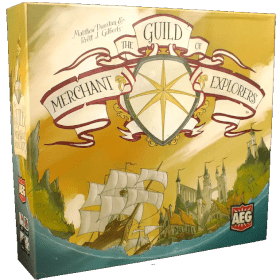 In The Guild of Merchant Explorers ogni giocatore inizia con una città sulla propria mappa personale.
Mescola il mazzo di carte terreno, quindi rivela la maggior parte di queste carte una alla volta. In base al terreno rivelato ogni giocatore posiziona sulla propria mappa cubi collegati alla propria città di partenza o ad altri cubi. Vuoi completare le aree sulla tua mappa, attraversare i mari verso nuove terre e stabilire nuove città sulla mappa. Puoi esplorare navi capovolte per cercare tesori, il che ti offre speciali capacità di posizionamento, e creare connessioni tra le posizioni per ottenere punti bonus. Gli obiettivi comuni possono essere completati da tutti i giocatori, con coloro che li completano per primi che ottengono più punti.
Alla fine di un round tutti i cubi vengono rimossi da ogni mappa, lasciando indietro solo le città, quindi se non stabilisci nuove città rimarrai bloccato negli stessi posti.
The Guild of Merchant Explorers contiene più copie di quattro mappe diverse e il gioco è progettato in modo che tu possa giocare da remoto con una o più copie.
In The Guild of Merchant Explorers ogni giocatore inizia con una città sulla propria mappa personale.
Mescola il mazzo di carte terreno, quindi rivela la maggior parte di queste carte una alla volta. In base al terreno rivelato ogni giocatore posiziona sulla propria mappa cubi collegati alla propria città di partenza o ad altri cubi. Vuoi completare le aree sulla tua mappa, attraversare i mari verso nuove terre e stabilire nuove città sulla mappa. Puoi esplorare navi capovolte per cercare tesori, il che ti offre speciali capacità di posizionamento, e creare connessioni tra le posizioni per ottenere punti bonus. Gli obiettivi comuni possono essere completati da tutti i giocatori, con coloro che li completano per primi che ottengono più punti.
Alla fine di un round tutti i cubi vengono rimossi da ogni mappa, lasciando indietro solo le città, quindi se non stabilisci nuove città rimarrai bloccato negli stessi posti.
The Guild of Merchant Explorers contiene più copie di quattro mappe diverse e il gioco è progettato in modo che tu possa giocare da remoto con una o più copie.
Numero di giocatori: 1 - 4
Durata della partita: 15 mn
Complessità: 2 / 5
Gioca a The Guild of Merchant Explorers e 1401 altri giochi online.
Nessun download, gioca direttamente dal tuo browser.
Con i tuoi amici e migliaia di giocatori da tutto il mondo.
Gratuito.


Gioca a The Guild of Merchant Explorers e 1401 altri giochi online.
Nessun download, gioca direttamente dal tuo browser.
Con i tuoi amici e migliaia di giocatori da tutto il mondo.
Gratuito.
Sommario delle regole
Goal
The goal of the game is to earn as many coins as possible. Players earn coins by placing explorers on cities, ruins, or discovery towers. Players can also create trade routes between cities, the capital, or other villages.
Gameplay
The game consists of 4 eras. In each era, players will take simultaneous turns after revealing explore cards until the exploration deck is exhausted.
At the end of each era:
- All explorers (cubes) are removed from the maps. Villages, trading posts, treasure tokens, and discovery towers are left on each player's maps.
- The next era's explore card is added to the exploration deck.
The game ends at the end of the 4th Era and the player with the most coins wins.
Spaces
There are 4 basic terrains to explore:
- Grassland
- Desert
- Mountain
- Sea
Each terrain space can be 1 of 5 different types:
Blank Spaces
Empty spaces where Villages may be placed.
Coin Spaces
Earn coins when explored.
Ruin Spaces
Special sea terrain; earn a Treasure Card when explored.
City Spaces
Connect 2 City Spaces to create a trade route.
Discovery Spaces
Special "wild" terrain; earn coins when explored.
Exploration cards
There are 5 basic exploration cards that will be available in every era:
- Explore one mountain space
- Explore up to two desert spaces (need not be adjacent)
- Explore up to two grassland spaces (need not be adjacent)
- Explore up to three sea spaces (must be adjacent and in a straight line)
- Explore up to two spaces of any terrain (must be adjacent; need not be the same type)
In addition, there is an era card for each era. The card(s) for the current and all previous eras will be shuffled into the exploration deck with the five basic cards.
The first time each era card is drawn, each player will draw two cards from the investigate deck and choose one to keep. They will use the associated special exploration action every time that era card is drawn, immediately and in future eras.
The fourth era card is special. Instead of drawing new investigation cards, each player will choose one of their existing investigation cards from eras I, II, or III to use. That action will be used immediately, as well as when its own card is drawn.
Placing explorers
Players may simultaneously place explorers based on the currently revealed explore card.
Players must place their explorers directly adjacent to the following:
- The capital space
- Previously placed explorers
- Player villages
Place explorers one at a time. All special actions (below) occur immediately upon placing the necessary explorer. If there are still explorers to be placed, they will continue to be placed after the action is completed.
Discovering villages
Discover new villages by fully exploring a region in a single era.
A region is a contiguous group of tiles of the same terrain.
When a region is fully explored for the first time, immediately replace an explorer on one of the blank tiles in that region with a village. Then, score coins equal to the current era.
Each region may only have one village.
Villages will not be removed at the start of each era, as opposed to explorers.
Creating trade routes
Connecting 2 city spaces creates a trading route. Cities can be connected with a chain of explorers, villages and/or your capital.
When creating a trade route, multiply the values of both cities and gain that amount of coins.
Then, cover up one of these cities with a trading post. This city can not be part of a trading route anymore.
Discovery spaces and towers
Discovery spaces are "wild" terrain, which means it can be explored with any type of exploration action.
When explored, gain coins based on how many other Discovery Spaces have been explored by the player (6/8/10/14).
Then, cover up the space with a Tower. This space can not be scored again.