
Seotda
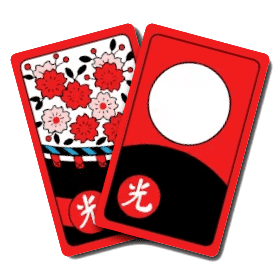 Seotda (anche noto come Sutda) è un gioco di carte di scommesse Coreano simile a Oicho-Kabu. Inizialmente giocato con le Tujeon, oggi il gioco utilizza invece le Hwatu o le Hanafuda. I giocatori scommettono sul valore delle loro carte distribuite in più round come nel Poker o altri giochi simili. Le mani a Seotda sono composta da 2 carte.
Questa implementazione supporta anche il Dorijitgo-ttaeng, che richiede ai giocatori di formare una combinazione di tre carte il cui valore totale è divisibile per 10 e poi utilizzare le restanti due carte nella loro mano di 5.
Le immagini Hwatu di Marcus Richert e le immagini Hanafuda di Louie Mantia Jr. sono utilizzate sotto la licenza Free Art 1.3, che è compatibile con la licenzza CC BY-SA 4.0.
Gli effetti sonori Hwatu di JICA (Jeonju) sono utilizzati sotto la Licenza Korea Open Government Type 1.
Numero di giocatori: 2 - 8
Durata della partita: 5 mn
Complessità: 1 / 5
Gioca a Seotda e 1408 altri giochi online.
Nessun download, gioca direttamente dal tuo browser.
Con i tuoi amici e migliaia di giocatori da tutto il mondo.
Gratuito.

Gioca a Seotda e 1408 altri giochi online.
Nessun download, gioca direttamente dal tuo browser.
Con i tuoi amici e migliaia di giocatori da tutto il mondo.
Gratuito.
Sommario delle regole
Game Overview
In the high-stakes world of Korean gambling, players face off in Seotda, a tense battle of luck and psychological warfare. Thematically, you act as a bold gambler aiming to create the most powerful combination using only two cards. Mechanically, the game utilizes a condensed Hanafuda deck where strategic betting and calculated bluffing are essential to force opponents to fold before the showdown.
Goal of the Game
The goal is to hold the highest-ranking combination of two cards or to win the pot by bluffing opponents into folding.
Gameplay
Preparation
- A reduced deck of 20 Hanafuda cards is used (months 1 through 10, two cards per month).
- Each player is dealt 2 cards (in the 3-card variation, one card is discarded before the final bet).
Betting Phase
Once cards are dealt, players choose their actions:
- Die: Fold and forfeit the current stake.
- Call: Match the current bet.
- Raise: Increase the stakes.
- All-in: Bet all remaining capital.
End of Round
If multiple players remain after the betting phase, a showdown occurs. Hands are revealed, and the player with the strongest combination takes the entire pot.
Combinations (Ranking)
| Rank | Name | Description |
|---|---|---|
| 1 | 3-8 Gwang-ddeng | The ultimate hand, consisting of the special cards from months 3 and 8. |
| 2 | 1-3 / 1-8 Gwang-ddeng | The second-highest tier (special cards from months 1 & 3 or 1 & 8). |
| 3 | Ddeng | Two cards from the same month (e.g., two 10s = Jang-ddeng). |
| 4 | Ggeut | The sum of the two cards' months (last digit only). A 9 is the highest standard value (Gabi). |
Game End & Scoring
- The game ends after a fixed number of rounds or when only one player has capital left.
- Re-deal: In the event of a tie for the highest hand, the pot is typically carried over to the next round rather than split.