
Pisanki
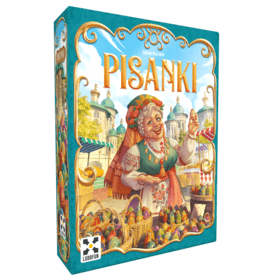 Pisanki è la tradizionale arte di dipingere le uova di Pasqua, celebrata dai popoli slavi, principalmente in Polonia e Ucraina.
In questo gioco preparerai la migliore presentazione delle uova Pisanki per deliziare le persone di tutto il mondo.
A ogni round, i giocatori riveleranno e acquisiranno nuove carte raffiguranti le uova decorate, i fiori e le tovaglie, per formare il loro tavolo di presentazione.
In base all'ordine in cui vengono acquisite le carte, il giocatore potrà anche guadagnare punti movimento per ordinare le carte acquisite sul suo tavolo, che verranno conteggiati alla fine della partita in base alla loro posizione rispetto alle altre carte e in base alle carte punteggio impostate all'inizio della partita.
Il giocatore con il punteggio più alto sarà considerato il vincitore.
Numero di giocatori: 2 - 5
Durata della partita: 7 mn
Complessità: 1 / 5
Gioca a Pisanki e 1414 altri giochi online.
Nessun download, gioca direttamente dal tuo browser.
Con i tuoi amici e migliaia di giocatori da tutto il mondo.
Gratuito.


Gioca a Pisanki e 1414 altri giochi online.
Nessun download, gioca direttamente dal tuo browser.
Con i tuoi amici e migliaia di giocatori da tutto il mondo.
Gratuito.
Sommario delle regole
Pisanki - Quick Rules
Pisanki is a strategic card game where players collect and arrange decorated Easter eggs (Pisanki) on their display table to score the most points through clever positioning and majorities.
Gameplay Flow
The game lasts several rounds. Each round consists of the following phases:
1. Preparation Phase
- Depending on the number of players, cards are drawn from the deck and placed face-up next to the numbered Offer Cards (1 to 5).
- These cards feature combinations of eggs, flowers, and different tablecloth backgrounds.
2. Acquisition Phase
- Starting with the lead player, each player chooses one of the available cards.
- Choosing a lower-numbered card grants a better turn order position for the next round.
3. Placement and Sorting Phase
- The acquired card must be placed immediately into the player's Display Table (a 3x4 grid).
- Using Movement Points:
- If the player purchased 1 card, he will have 2 moves to make
- If the player purchased 2 card, he will have 1 move to make
- 1 move:A card can be moved vertically or horizontally to any position in that direction; the other cards in the column or row must be slid to fill the empty space.
- 2 Points: The same card can be moved twice (if the player has 2 moves).
Categories and Symbols
When choosing cards, players should consider these key elements:
- Egg Types: There are 6 different patterns/colors. These are vital for majority scoring.
- Flowers: Found on some cards. They provide bonus points based on the active Flower scoring cards.
- Tablecloths (Backgrounds): The color or pattern of the background influences tablecloth scoring (e.g., groups of matching colors).
- Double Eggs: Cards showing two eggs count twice for majority checks.
End of Game and Scoring
After 12 rounds, the 3x4 display is full. Scoring occurs in four categories:
- Egg Majorities: The player with the most eggs of a specific type wins the points on the corresponding scoring card.
- Flower Scoring: Points based on the total number of flowers collected.
- Tablecloth Scoring: Points for the arrangement and patterns of the card backgrounds.
- Display Scoring: Points for meeting specific objectives (e.g., specific eggs in the corners of the grid).
The player with the highest total score wins.