
Forage
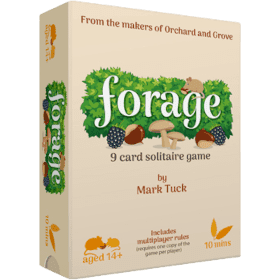 Forage è il capitolo finale della trilogia di giochi solitari a 9 carte (dopo Orchard e il suo sequel Grove).
LE sue 18 carte mostrano differenti tipi di aree boschive, dove troverai more selvatiche, dolci castagne e funghi commestibili. Alcune aree sono divise in due tipi, che, insieme con il dado personalizzato con i topi famelici del legno, offrono nuove opportunità e differenti strategie per incrementare la tua raccolta.
I retri delle carte presentano sfide di ricette con diverse condizioni di punteggio e obiettivi di punteggio. Queste forniscono una condizione di vittoria/sconfitta (come un'alternativa alla normale condizione 'batti il tuo punteggio') per chi la preferisce - e aggiunge più varietà al gioco.
Numero di giocatori: 1
Durata della partita: 5 mn
Complessità: 1 / 5
Gioca a Forage e 1414 altri giochi online.
Nessun download, gioca direttamente dal tuo browser.
Con i tuoi amici e migliaia di giocatori da tutto il mondo.
Gratuito.


Gioca a Forage e 1414 altri giochi online.
Nessun download, gioca direttamente dal tuo browser.
Con i tuoi amici e migliaia di giocatori da tutto il mondo.
Gratuito.
Sommario delle regole
Forage (Herbsthain)
Forage is a solo card-layering game where the player overlaps forest cards to create large groups of identical berry and fruit symbols. The goal is to achieve the highest score through clever placement and the strategic use of dice.
Game Objective
Reach the highest possible score by overlapping cards and forming groups of identical symbols. The game ends once all 18 cards in the deck have been played.
Game Setup
- Shuffle the 18 cards.
- Draw 2 cards as starting cards and place them side-by-side or slightly overlapping.
- Draw one card into your hand. The remaining cards form the draw pile.
- Keep the dice ready to mark points on the cards.
Gameplay
The game consists of a series of turns until the draw pile is empty and the final hand card has been played. A turn follows these steps:
1. Place Card
- Play your hand card onto the cards already on the table.
- Overlapping Rule: The new card must cover at least one square of a card already in play.
- Matching Symbols: If you cover a symbol (e.g., blackberries) with an identical symbol on the card below, you earn points.
2. Mark Points (Dice)
- When symbols match, place a die on the square of the topmost card.
- First Match: Place a die showing the number 1 on the square.
- Subsequent Matches: If you later overlap an identical symbol onto a square that already has a die, increment the die value (1 → 3 → 6 → 10 → 15, the last value is reserve for the mice).
- Maximum Value: A die can reach a maximum value of 15.
3. Draw
- Draw a new card from the pile into your hand (while supplies last).
Special Rules & Symbols
The Path (Trail Symbols)
- Many cards show sections of a forest trail.
- By aligning or overlapping paths correctly, you create a continuous trail.
- Trail Bonus: At the end of the game, you earn extra points for your longest continuous path of trail symbols.
Forks and Crossings
- Some cards allow the path to branch in different directions. These are vital for staying flexible as new cards are drawn.
Final Scoring
After the 18th card is placed, calculate the final score:
- Berry Points: Sum the values of all dice currently on the cards.
- Trail Points: Count the number of trail symbols in your longest continuous path (each symbol equals 1 point).
- Penalties: Depending on the difficulty level or scenario, points may be deducted for uncovered "rotten" symbols or isolated squares.
Player Decision Factors
- Efficiency: Is it better to start a new symbol group (value 1) or increase an existing die?
- Path Planning: Should I extend the trail or sacrifice a path segment to complete a high-scoring berry combination?
- Card Management: Which symbols are still left in the deck? (Strategic planning for the remaining turns).